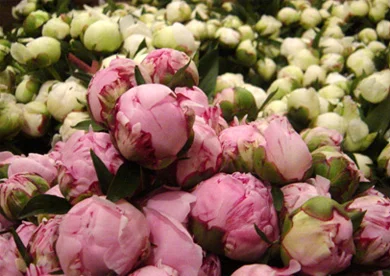
Local Peony season is officially here, we have been sourcing locally grown peonies from numerous from the New England and Tri State areas. A few questions we always receive is why are peonies expensive. Numerous factors dictate the price of peonies, demanding being the biggest factor but a few others also dictate the price,
In the Mid Atlantic, peonies are one of the earliest field grown flowers commercially available to wholesalers. They are long lasting and have a fantastic shelf life within the chain from grower to end user. Finally, demand is always high, especially around Mother’s Day and the beginning of wedding season. Any one of these factors would make the price high, but peonies cover all the bases. The market demand helps to set the pricing. However, growing conditions in the Carolinas and a few places south of that also has an impact on the market. If the big growers are at full production, prices are lower and conversely if their production was hampered in any way prices are higher.
Most consumers are unaware that buying direct from farms like we do, is the different grades in flowers. Certain grades yield higher pricing such as length of stem, head size and a few other details. The longer the stem means the peony has been maintained by the farm longer therefore yielding a higher price point. Lower grade flowers are usually sold to supermarkets as the length is shorter and heads are smaller resulting in a cheaper price point.
”Field grown peonies take around three years to yield any commercially viable production.
Purely from a growers perspective, peonies are a long term crop. Anyone getting into it has to be willing and able to set aside the acreage for a minimum of around 10 years. That acreage is off limits for other crops for the duration of the peony project. Plant material is an expense that can vary by variety, but the labor is all the same – they have to be planted by hand. Soil borne diseases can set in at any time and start to reduce the return on investment of the long term project. Field grown peonies take around three years to yield any commercially viable production – for instance, you may only get 3-4 stems per plant in the early portion. As the plants mature, they produce more stems. They will eventually reach a stage where they are producing too many stems and the head size suffers. This is when a grower will need to manually dig and divide from his clumps to reduce the density. All of this work is done by hand as far as I know, and that is not cheap. Stem production will decrease at this time due to the trauma the plant endures – not quite like going back to square one, but still a cost and factor in production. Compared to other crops, these are the factors that shape market pricing.
Why is the peony variety Coral Charm the most expensive?
Everything above is true for Coral Charm, with two added factors. Plant material for this variety costs more and they happen to be the first to bloom; both push the price up. I would also say that the supply side of Coral has never really matched the demand, which also increases the market price. If the supply side changes, prices may change as well. From a growing perspective, they are really no more difficult than any other peony; some nuances, yes, but no major difference.